


Cerrado das Águas promotes ecological restoration strategies with the Biodiversity and Coffee Workshop

The initiative took place on Cerrado Day and brought together producers, companies, institutions, public authorities, and society to strengthen the construction of biodiverse and productive landscapes in the Cerrado region of Minas Gerais.
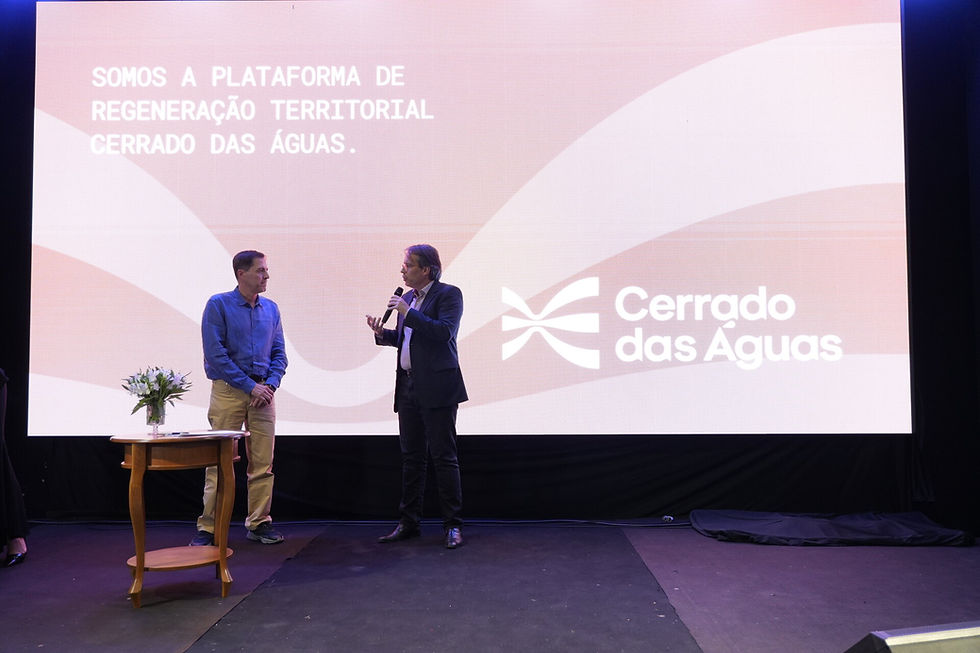
Patrocínio (MG) – The Cerrado das Águas Consortium (CCA) advanced to another stage of the project “Ecological Restoration and Coffee: building biodiverse and productive landscapes,” which foresees the restoration of 202.32 hectares in strategic areas of the Cerrado Mineiro region with the Biodiversity and Coffee Workshop - Strategies for sustainable production, held on September 11th at the Coffee Excellence Center in Patrocínio-MG.
The event brought together producers, public institutions, and project partners to discuss solutions for ecological restoration, water management, and the integration of production and conservation in three fundamental hydrographic basins for agriculture and for supplying water to municipalities in the region: the Santo Inácio River (Coromandel), the Ribeirão Grande (Serra do Salitre), and the Córrego Feio (Patrocínio).
The program included a reception with a tasting of specialty coffees offered by Lidi Cafés Especiais, followed by a presentation of the Study of the Regenerative Landscape of the Cerrado Mineiro and the Ecological Restoration Plan, a lecture by the State Forestry Institute (IEF) on restoration and the Rural Environmental Registry (CAR), as well as a round table discussion between producers and the public.
“Especially on Cerrado Day, we presented an ecological restoration plan from the Cerrado das Águas Consortium, an initiative of the Floresta Viva grant program, funded by BNDES, Petrobras, and the managing body Funbio. It was a very enriching moment to show what has been built for this project, whose main goals are the restoration of 202 hectares in the municipalities of Serra do Salitre, Coromandel, and Patrocínio, and includes the training of rural producers, the monitoring of various environmental indicators, and the production of organic compost for these areas that will be restored on 25 properties. Therefore, this was the moment to present to the producers what will be accomplished with their support over the next four years,” explains Mariana Santos, restoration specialist at CCA.
A united effort for the Cerrado biome
With the presence of rural producers from the hydrographic basins and representatives of associated companies, partner institutions, and public authorities, such as representatives from the Environment and Agriculture Secretariats of the municipalities involved in the project, the CCA promoted debates and analyses on paths and possibilities to strengthen agricultural practices that reconcile productivity, landscape restoration, and conservation of natural resources, a moment approved by the producers.
“Initiatives like this event are very important, both for bridging the gap between producers and public institutions, and for raising awareness. This is also a tool that producers have to adopt sustainable practices for water resource management and to understand that this also leads to social, environmental, and especially economic contributions. Collaborating is much better, because alone, the producer is stuck with the operational aspects and activities of the rural property, that is, our day-to-day demands; and being able to count on Cerrado das Águas is very beneficial.” Reviews Coromandel producer Farley Marra.
During the workshop, producers shared experiences, debated challenges, and discussed solutions to practically unite production with the preservation of local biodiversity. They also discussed ways to expand ecological corridors and strengthen essential ecosystem services, such as water conservation and increased climate resilience, all through the collaboration of the various sectors present at the event.
“In our Biodiversity and Coffee Workshop, the CCA managed to put its essence into practice. We had cooperatives, producers, associated companies, the public sector, everyone together and working together. This is the challenge and the secret, and it is the CCA's strong point: uniting everyone, working towards the same goal, with different opinions and points of view, but the objective is the same. With initiatives like this, rural properties stop having a vision of what causes a negative impact and become protagonists, causing a positive impact. This is a total difference in mentality, in the way of producing and impacting the region. These are farms with regenerative agriculture that are connecting points between the fragments of the Cerrado,” says Marcelo Urtado, rural producer and president of the CCA.
The union of the CCA's collaborative platform's associate members strengthens the work of producers in implementing restoration strategies and reinforces the CCA's commitment to caring for and connecting landscapes, making them biodiverse and productive.
“I am very happy to have participated in this event, to have been able to meet with other associates, with producers, and to be close to and in contact with all these projects that the CCA has been carrying out in the Cerrado Mineiro region. It was also an opportunity to deepen our knowledge of the Cerrado biome, and we are very proud to be associates, supporting and participating in this innovative new project that the CCA is developing with the Floresta Viva grant. It will be extremely important for the region and for Brazil because it will place agriculture at the center of the region's sustainability,” assessed André Pessina, representative of xFarm, a CCA associate member company.
Objectives for Strengthening the Production Chain
The project “Ecological Restoration and Coffee: Building Biodiverse and Productive Landscapes” is funded by Petrobras and BNDES through the Floresta Viva (FUNBIO) grant program. The initiative promotes the restoration of Permanent Preservation Areas (APPs) and Legal Reserves (RLs), also strengthening the restoration production chain with training, supplies, and incentives for job creation in rural areas. The initiative is part of the RIDE DF/Paranaíba/Abaeté Ecological Corridor, which was launched by the CCA at an event in Brasília in April.
The project's main goal is the restoration of 202 hectares, and the main planned activities include the implementation of ecological restoration practices, training for rural producers, monitoring of environmental indicators, promotion of seed collection and production of native seedlings, and the implementation of organic composting structures, aiming to reduce costs and strengthen the restoration production chain. In an integrated manner, the initiative aims to reconcile the maintenance of ecosystem services, the improvement of climate resilience, and the generation of rural income, with attention to gender equity and the socioeconomic inclusion of the families involved.
Project Progress and Next Steps
Among the results already achieved, the following stand out: the Climate Adaptation Plans (CAPs) developed for each participating property, considering local and productive characteristics; the production of organic compost, in partnership with Fazenda 5 Estrelas and SANA Consultoria Agroecológica, with a forecast of 1,000 tons for use in restoration plantings; mapping of the restoration chain, which identifies actors linked to seeds, seedlings, biological inputs, labor, and communication, strengthening the network of environmental services in the Cerrado; and the implementation of water monitoring systems, including limnimetric gauges and meteorological stations in the three priority basins.
About the CCA
The Cerrado Waters Consortium (CCA) is a collaborative platform that includes various sectors, such as companies, government, and civil society. It is an initiative of the coffee production chain that seeks to build climate resilience and water availability in the Cerrado Mineiro region through strategies that promote better land use, ensuring the continuity of coffee production in the region and mitigating the impact of climate change.
Through the Conscious Producer Investment Program (PIPC), the CCA team guides, supports, and encourages producers in implementing strategies for the provision of ecosystem services, focusing on improving the supply of water resources to all producers whose properties are adjacent to a given basin, making the region resilient to climate change. As a result, the CCA has 202 hectares of conserved native vegetation, 4,000 hectares of agricultural land in transition to regenerative agriculture, and benefits 150,000 people.
The initiative has the following companies as associate members: Nescafé, Expocaccer, Nespresso, Lavazza, Cooxupé, Cofco International, Volcafe, NKG Stockler, Daterra, Federação dos Cafeicultores do Cerrado, CerVivo, Starbucks Farmer Support Center, JDE Peet's, EISA, and X-Farm. In addition, the platform has key partners such as the Municipal Governments of Serra do Salitre and Coromandel.



Comments